
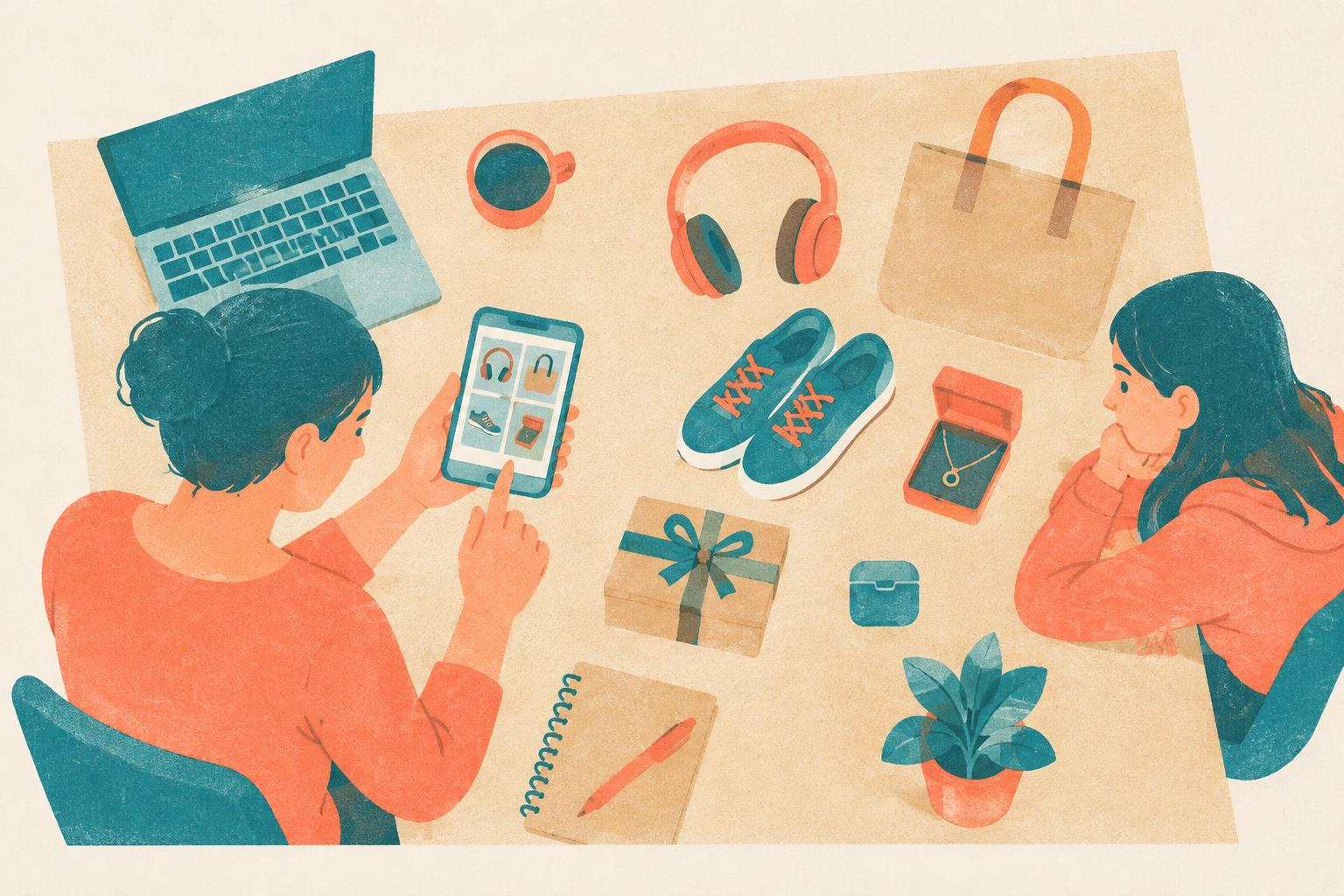
A marketplace listing that says "for girls 7-14" tells you nothing about which end of that range the product was designed for. That single age label on a journal kit or bracelet set is the most common reason a gift for a teen lands badly, and the fix is to read the contents list and the finished size instead. Which gift ideas for teen girls work depends far more on how much time you have left than on how well you know her — the thing you can verify, source and deliver in three days is a different category from the thing you can plan over a month.
So the organising question here is the deadline. A birthday on Saturday, a farewell on the last day of term, a Diwali gathering at a neighbour's, Eid at your manager's house where there are three teenagers and you have met them twice.
What the occasion expects before you choose anything
The register problem is sharper with teenagers than with adults, because you are usually buying through a parent and have no direct read on her taste. If you are a colleague buying for your manager's daughter at Eid, you are not buying for her, strictly — you are buying something that reflects well on the relationship. That argues for something neutral and clearly new in its packaging: a good notebook and pen set, a book in a genre you have been told she reads, a gift card to a bookshop or a general marketplace. The notebook is the one to think twice about — a teen who journals regularly already owns notebooks she chose herself, probably better ones than you will pick blind. All three arguments fail for anything that implies you know her personal taste when you do not, and for clothing, perfume or anything worn on the body.
Across cultural lines in a UAE office, the safe exclusions are the usual ones and they are real: nothing containing alcohol, including gift sets with liqueur chocolates, and nothing pork-derived. Jewellery is the one Western instinct worth suppressing. Gold and jewellery carry weight here that they do not carry in Western gifting norms, which makes them the wrong register for someone you know only through her parents. If you want to give something that goes on her, give a craft kit that makes one.
A farewell for a family leaving the country changes the calculus entirely. Anything bulky is a burden in a suitcase or a shipping container, and anything mains-powered depends on the plug and voltage at a destination you may not know. For a leaving gift, think small, light, and not dependent on a regional account: a paperback, a sketchbook, a set of pens she will use on the flight. The sketchbook is wrong if you do not know what medium she works in, and the paperback is wrong if she reads on a screen — which is one question to a parent, not a guess.
For a close family birthday, the register is reversed. Something too neutral reads as an afterthought from an aunt who did not ask. This is where the device, the subscription or the experience makes sense, because you have standing to ask her parents what she already owns.

This week: what you can verify and get there in time
With days left, the facts you need are narrow: her genre, her phone, and whether she already owns the thing. Anything already in the country from a UAE marketplace is the difference between a predictable arrival and an order that has to clear customs.
Books are the strongest short-notice gift for a teen reader, and the worst one if you guess. The failure modes are specific and all avoidable: buying book two of a series, buying a title she finished last month, buying the English edition when she reads in Arabic or Russian, or buying a hardcover when she only reads on a screen. Before you order, you need one fact — genre, or a title she has mentioned. Ask a sibling, ask a parent, ask her. A current bestseller is not evidence she wants it, and the duplicate risk is highest on exactly the title everyone is talking about. Lauren Roberts's Powerless is a young-adult hardcover of the kind that circulates in that category; naming it tells you nothing about whether she has already read it, which is the only thing that decides the purchase.
Stationery and durable creative supplies are the other reliable short-notice class, and the one most often bought wrong. A hundred-colour marker set is not better than twelve markers in the right medium. Check what the pens are — alcohol-based, water-based, acrylic, archival — because alcohol markers bleed through ordinary notebook paper and will ruin the journal she keeps. If she paints or uses brush pens, paper weight in gsm is on the listing and it decides whether the gift is usable. A sketchbook at low gsm with wet media is a gift she will abandon after two pages. This class assumes she already has a practice; if you do not know what medium she works in, you are guessing and a hundred colours will not cover for it.
Creative consumable kits are the fastest option and the easiest to get wrong for an older teen. The test is whether the listing names the projects, the quantities and the finished size, rather than a piece count. A kit advertising 14,000 pieces tells you nothing about whether the cord is strong enough or whether a clasp is included; a kit claiming 70-plus pieces may be sixty stickers and a blank notebook. Kits that advertise decorative pieces often omit glue, thread or batteries, so check that those are in the box. And check the finished size: a journal kit that produces something pocket-sized disappoints a fifteen-year-old who wanted a proper notebook. For a thirteen-year-old who is new to crafting, the same kit is fine.
Audio is buyable this week if you know her phone. Earbuds and small Bluetooth speakers are safe in register and almost never duplicated badly, but compatibility is not decorative. Check the charging connector — USB-C if her other devices are USB-C — and look for a stated IP rating rather than the words water-resistant, if she will take it to the pool or the beach. Multipoint connection matters more to a teen juggling a phone and a laptop than any difference in headline battery hours. This assumes she does not already own a pair, and it assumes a parent has not bought the same thing, which is exactly the duplicate risk you cannot check alone.
This month: things that need one question answered first
Three or four weeks buys you the one thing a short deadline does not: time to ask a parent what she owns, what account she uses, and what her phone is, and to wait for the answer before ordering.
Creative technology comes into range here, because it needs verification you cannot do in a day. An instant camera or a phone photo printer is a strong gift for a teen who already shoots and edits on her phone, and a dead weight for one who does not. The attribute that decides it is the consumable: the exact film or paper format, and whether packs of it are sold locally. Fujifilm's Instax line and HP's Sprocket printers are the obvious examples of each category, and in both cases the question is identical — can she buy more film or paper here, without you, when the first pack runs out. Printers also typically require an app and a specific operating-system version, so check the supported phone models against the phone she has. A camera that depends on an app unavailable in her region is a decorative object.
Tripods, clip lights and small microphones suit the teen who already makes video. If she does not shoot video, this is equipment for a hobby she does not have, however good the specification. Where she does, these fail on mechanical detail rather than concept: thread size, the width of phone the clamp accepts, the adjustment range, and for lighting, whether the colour temperature is adjustable or fixed. She may already own a ring light, so ask before buying lighting.
An e-reader is the gift a reader will use daily, and it carries one assumption worth naming out loud. The device does not come with books. Before buying, check what store account she would use and whether the titles she wants are available to her through it, along with storage, screen size and the charging connector. Battery figures quoted for e-readers — twelve weeks and similar — are manufacturer-condition claims, not what she will get with the backlight on. Confirm store and library access for the account she would use, in the UAE, before you commit.
Subscriptions and classes belong in this window because they need setup by an adult. A monthly book or craft box, an online art or coding course, in-person music lessons — these suit a teen with an identified interest and the motivation to show up more than once. The things to check are unglamorous and decisive: whether the service accepts UAE addresses or enrolment at all, whether billing renews automatically, whether months can be skipped, what the minimum age is, and whether a parent needs to hold the account. For a live class, confirm the session times in UAE hours before you buy. If the course requires materials or software she does not own, you have bought her a bill.
This is also the window where a group gift becomes possible. If four colleagues are chipping in for a leaving family's teenager, or a group of parents is coordinating a birthday, the duplicate risk is the whole problem — two people buying the same earbuds because nobody said anything. On a shared wishlist page, like the ones you can put together on WishDune, guests can reserve an item without making an account, so the second person sees it is taken.
Further out: planning around a date rather than buying against one
With a month or more, an experience becomes possible, and it suits a teen who would rather be out with friends than unwrap another object. It is wrong for a teen who does not want to be committed to a date she did not choose.
A workshop, an escape room, a concert, a pottery or photography class, a sports session — each requires a date, transport, and often adult supervision. The attributes that sink these are administrative: the age or height minimum at the venue, the validity period on a voucher, blackout dates, the language of instruction, whether the booking includes equipment and materials or only admission, and whether someone over eighteen must attend. If she is fourteen and the venue requires sixteen, the voucher is worthless and the failure is visible in front of everyone. Check the current terms directly with the venue before you commit to a date.
Experiences also carry a scheduling obligation. If you give a class, you have implicitly promised to help arrange it. For a colleague's daughter, that is too much of an entanglement and the gift is the wrong register. For a niece, a cousin or your own child, it is the point.
FAQ
A bookshop or general marketplace gift card, given openly rather than apologetically. It reads as respect for her taste rather than laziness, provided the occasion is one where a card is normal — a colleague's daughter at Eid, a farewell, a classmate. For a close family birthday it will read as effort you did not make.
Often, yes. Check the stated age range on the listing: anything written as 6-14 or 8-12 spans ages with very different expectations, so read the contents and the finished size rather than the label. A kit is right for a teen who is new to a craft and wants a finished result in an evening, and wrong for one who already journals or makes jewellery and owns better materials than the kit contains.
Better not. Gold and jewellery carry weight here that they do not carry in Western gifting norms, which puts them in the wrong register for someone you know through her parents. If you want something she can wear, a kit she makes herself avoids the problem.
Buy a backup that is already stocked in the UAE and give that on the day, then pass on the original when it clears. Anything crossing a border can be held, and you cannot predict it.
Ask one person who would know — a parent, a sibling, a close friend — and ask specifically, naming the item, not generally. For group buying, a shared list that people can reserve items from stops two relatives ordering the same thing without a conversation.
It can be, with one caveat you should settle first: the device does not come with books, and access depends on what store account she can use. Check the charging connector, the storage, and whether the titles she reads are available to her through that account. If she borrows physical books from friends constantly, she may not want one.
Anything containing alcohol, including gift sets with liqueur-filled chocolates, and anything pork-derived. Beyond that, avoid clothing, perfume and anything worn on the body for someone you know only through her parents. A book, stationery, a craft kit or a gift card keeps the register right.