
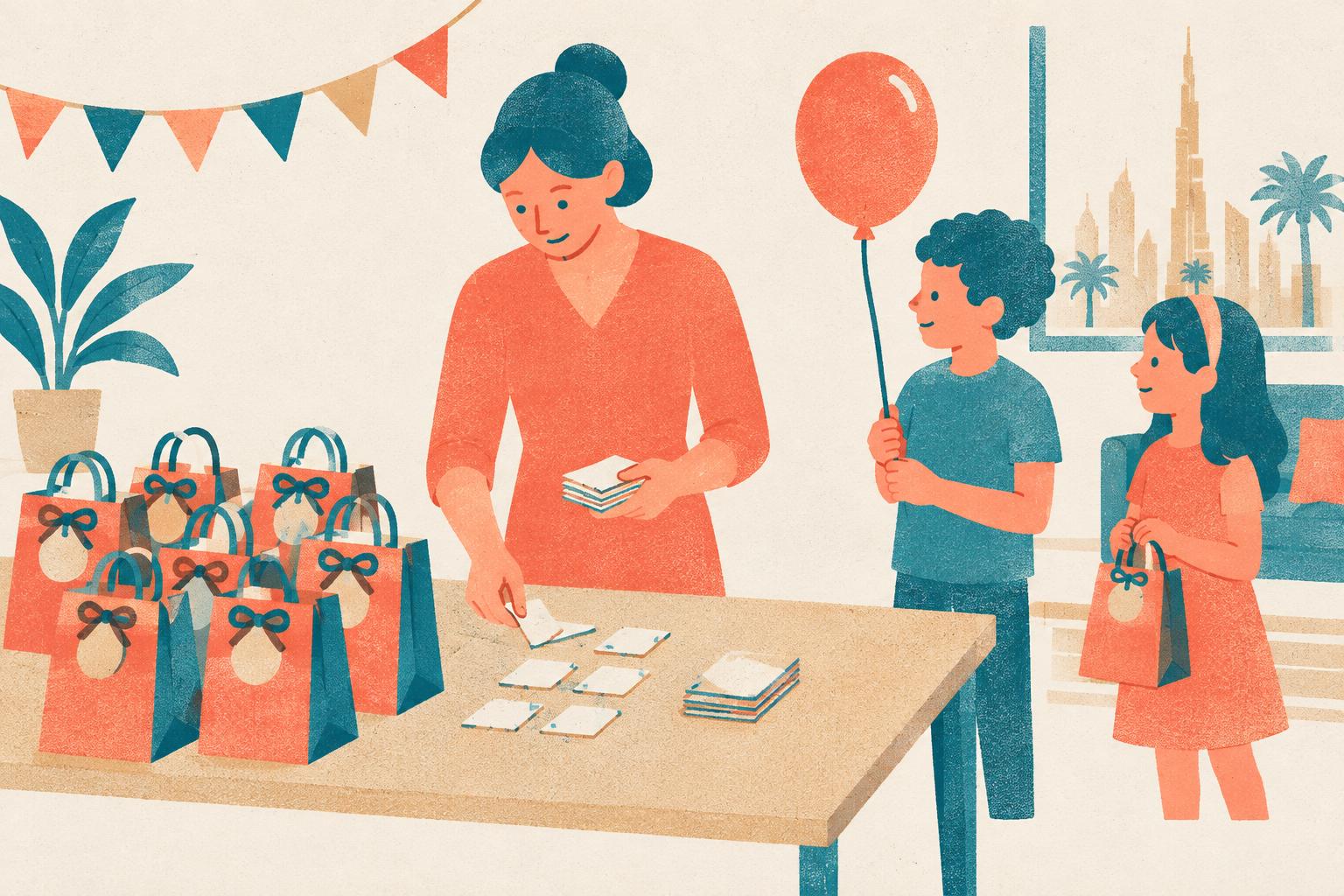
It is a Tuesday night in a villa in Mirdif, the party is on Saturday, and twenty-two children are confirmed. You have worked out the cake, the entertainer and the balloons, and now you are staring at the one line in the budget that nobody plans for properly: the thing each child goes home with. The sharpest version of the question is not what to give — it is what twenty-two of something can cost before the whole exercise stops making sense.
What birthday return gift ideas for kids in Dubai actually look like at your budget
Here is the answer, stated plainly: if your per-child figure only stretches to one small item, you get one decent object or a small bundle of cheap ones, and you cannot have both. Multiply your per-child figure by your guest count and you will see the real constraint immediately. A party of eight can carry a proper gift each. A party of twenty-five cannot, no matter how you arrange it, and the parents trying to do it anyway are the ones who end up at a hypermarket on Friday evening buying plastic that breaks in the car park.
So settle the total first and divide it by the number of children who will be in the room. Not invited — attending, plus a margin, because siblings arrive. That number dictates your whole category, and it is the only calculation that matters before you start looking at products.
What the money quietly rules out is personalisation at scale. Named items are the single most reliable way to make a small gift feel considered, and they are also the thing that breaks first when the guest count rises — not only because of cost but because every name has to be confirmed, spelled correctly, and ordered with enough time for production. More on that below, because it is where most of the preventable mistakes happen.
The second thing it rules out is variety. Parents who try to match a gift to each child end up with twenty-two separate purchases, twenty-two separate decisions, and no bulk pricing. The parties that work pick one format and repeat it.
The error worth naming is the middle-band party with a large guest count. You have enough money that a cheap bag feels embarrassing and not enough that a real gift is possible twenty-two times over. This is where people lose money to compromise: they buy the slightly-better plastic toy that is still plastic, still breaks, and costs noticeably more than stickers while lasting no longer. If the maths pushes you here, go down rather than halfway up — unless the host has already set an expectation with the invitation, or the party is small enough that a packet of stickers alone reads as an afterthought. Otherwise a packet of good stickers and one sweet the parents will approve of reads as deliberate. A mediocre toy reads as a budget that ran out.
When the per-child figure buys one small thing and nothing more
At the low end you are in sticker, stationery and small-sweet territory, which is fine. In the middle you can afford one thing that survives the drive home: a decent water bottle, a small building set, a craft kit. At the upper end you can personalise, or you can do an experience-style gift, but only if your guest count is small. Almost nobody is doing the last of those for a class party.
At the level most class parties run on, three formats hold up.
The first is a single good consumable. One proper item — a nice chocolate, a small packet of biscuits, a juice pouch from a brand parents recognise — placed in a plain bag with the child's name on a card. This is the cheapest option that does not look cheap, because the quality is visible in one glance and there is nothing else competing with it. The buying test is whether the ingredients are printed in English on the pack, so you can check them in the aisle rather than guessing from the packaging design. It fails if your guest list includes children with allergies you have not asked about, which at a Dubai school party it almost certainly does.
The second is stationery that gets used. Mechanical pencils, a small notebook, a set of gel pens, erasers in a shape. The test here is whether it survives a school bag: a pencil case item that splits or leaks on the first day is worse than nothing. Children at primary age use these, parents do not resent them, and they survive the car. This fails for under-fives, who will not use a pen and whose parents will quietly bin it.
The third is a single craft or activity item: a small modelling clay pack, a paint-your-own figure, a mini puzzle. Check the age marking and the piece count on the box before you buy in quantity, because that is where the difference between an afternoon's occupation and two minutes shows. These earn their place because they occupy the child for an afternoon. They fail at the very bottom of the budget, where the clay dries out and the puzzle has twelve pieces and no picture.
What does not hold up at this level, in my view, is the loot bag stuffed with six small things. It takes an evening to assemble and produces a bag of items each of which is visibly worse than the single item you could have bought instead.
What personalisation costs you in time, not just money
A child who finds their own name on a bottle or a bag takes it home rather than leaving it on the table. The problem is that personalisation changes the shape of your deadline.
The Happy Tribe, a Dubai-based personalised children's goods business, states on its own site that personalised items usually take two to four business days to make, followed by delivery of one to two days within Dubai and two to four days to the other emirates. It also advertises same-day delivery in Dubai for orders placed before 2 pm Monday to Saturday — and that is the trap. Same-day delivery does not override the production period. Those are two separate clocks, and the personalisation clock starts only once your details are approved. PrintOnline, another UAE personalisation service, is explicit about the same sequence: production begins after the artwork or personalisation details are approved, not when you pay.
Which means the thing that really sinks a personalised return gift is not the supplier. It is you, waiting on RSVPs. Names, spellings and attendance keep changing until the last few days, and production cannot start until they stop. If you are ordering named items, you need the guest list frozen earlier than feels natural, and you need to accept that late RSVPs will not get one.
There is a workaround that costs nothing. Order non-personalised stock for the body of the gift and personalise only the tag or card, by hand, the night before. You keep the recognition effect and you remove the dependency entirely. It breaks in two ways: handwriting twenty-two tags the night before a party is an hour you may not have, and a tag does not survive the car the way a printed name on the object itself does.
One more detail that matters more in Dubai than most places: check spellings against how the parent writes them, not how you heard them. Arabic and South Asian names transliterate several valid ways, and a wrong spelling turns a named gift into a gift the child cannot use. Ask in the group chat, in writing, and copy and paste.
The emirate you are delivering to is part of the budget
Delivery timings split by emirate, and they split by supplier too. The Happy Tribe publishes one to two days for Dubai after production and two to four days for the other emirates; other UAE suppliers set their own windows. Ask your supplier for the figure for your emirate specifically rather than reading a Dubai promise as a UAE-wide one. If your party is in Sharjah or Ras Al Khaimah, you are on the slower clock, and that clock has to be checked before you order anything personalised.
Venue access is the other cost nobody budgets. Before you order, confirm with the venue whether it can receive and store a parcel at all, and get the name of a person who will sign for it. If you cannot get both, have everything delivered to your own address and transport it yourself. Twenty-two small bags fit in a boot. That fails if you are not driving to the venue, or if the item is bulky enough that twenty-two of them do not fit in a car with the cake.
If part of the order is coming from outside the UAE, treat it as a separate and unreliable stream. Something already in the country and something that has to clear customs are not comparable, and you cannot plan a fixed date around the second one. For return gifts, which are needed in quantity and on a specific day, overseas ordering is a bet you do not need to take.
What gets quietly rejected at a mixed Dubai party
A class party in Dubai means Muslim, Hindu, Christian and non-religious families in the same room, and several nationalities inside each of those. Return gifts go home with children and get inspected by parents, which is the point at which a mistake shows.
Sweets are where this bites hardest. Gummies, marshmallows and some chocolate assortments carry gelatin of unclear origin, and anything with alcohol-based flavouring is out. If you are handing out food, read the ingredients and the halal marking on the pack rather than the packaging design, and if you cannot confirm it, choose something simple — a plain biscuit, a known chocolate brand — over a pick-and-mix.
Beyond food, the categories that cause trouble are narrower than people expect. Toy weapons, including water pistols and anything that looks like a firearm, are not a safe default. Cosmetics, nail products and anything body-related make a share of parents uncomfortable and are awkward to size or match. Religious imagery used decoratively, including Arabic script chosen for how it looks, is worth avoiding entirely. And unless the host has set a theme, keep the packaging to birthday colours rather than Christmas or Halloween, because not every family in the room marks those.
When the return gift is for one child, not twenty
Smaller parties change the answer completely. With six or eight children, the per-child budget supports a real object, and the calculation flips from unit cost to appropriateness. A book chosen for the child's age, a small building set, a decent sketchbook and pencils — these work at eight guests and are impossible at twenty-five.
The risk at this end is duplication. A six-child party is usually six children who see each other weekly, which means they own the same things, and the small building set you picked is the one half of them got at the last party. You cannot check this without asking, so ask directly in the group chat.
The same duplication problem runs the other way with the birthday child's own presents, where several families are buying at once and nobody can see what the others chose. A shared wishlist page that guests can reserve from — WishDune does this without anyone needing an account — stops two of them arriving with the same box.
For a party this size, the personalised route finally becomes practical, because six names can be confirmed and spelled correctly without a project plan. This is the one case where the production time is worth absorbing.
The thing to decide tonight
Pick the format before you pick the product. Format means: one consumable, one stationery item, one activity item, or one named object — chosen once and repeated. Everything else follows from that choice, including whether you have time to personalise, whether you can order online at all, and whether your per-child figure is realistic for the number of children walking through the door.
If you cannot decide, count the guests again. Twenty-two children and a modest total means consumable or stationery, bought locally, bagged at home. That is not a compromise. It is the answer the arithmetic gives you.
FAQ
Work backwards from a total you are comfortable with rather than from a per-child figure, because the guest count does the real damage. A class party of twenty-plus and a party of six are completely different problems, and the per-child number that works for one is impossible for the other. Settle the total first, divide, and let that decide your category.
No. Pick one format and repeat it; individual matching takes far more effort than it is worth and nobody at the door notices it. What reads badly is a gift that is obviously filler — three pieces of plastic in a bag — rather than one thing repeated twenty-two times.
Possibly, but check the production time separately from the delivery time. The Happy Tribe, for example, states that personalised items usually take two to four business days before dispatch, and its same-day Dubai delivery does not change that. If your party is in a different emirate, ask the supplier for its delivery window to that emirate specifically.
Avoid gummies, marshmallows and anything with gelatin you cannot trace, plus anything with alcohol-based flavouring. Packaged biscuits and chocolate from brands with clear halal marking are the low-risk choice. Ask about nut and dairy allergies in the parent group chat before you buy, not after.
Have everything delivered to your home and bring it with you. Confirm the receiving arrangements with the venue before you order — whether it can take a parcel at all, where it would be stored, and who will sign — because chasing a delivery you cannot sign for on the day of the party is the worst possible use of that hour.
If your deadline is tight and you have not ordered yet, buying in person removes every variable at once. Online makes sense when you have more than a few days, when you want quantity pricing, or when you are personalising — and in that last case the clock starts when you confirm the names, not when you place the order.
Toy weapons of any kind, cosmetics and body products, and anything using religious imagery or Arabic script as decoration. Also skip festival-themed packaging unless the host has set that theme, since not every family in a Dubai classroom marks the same occasions.